
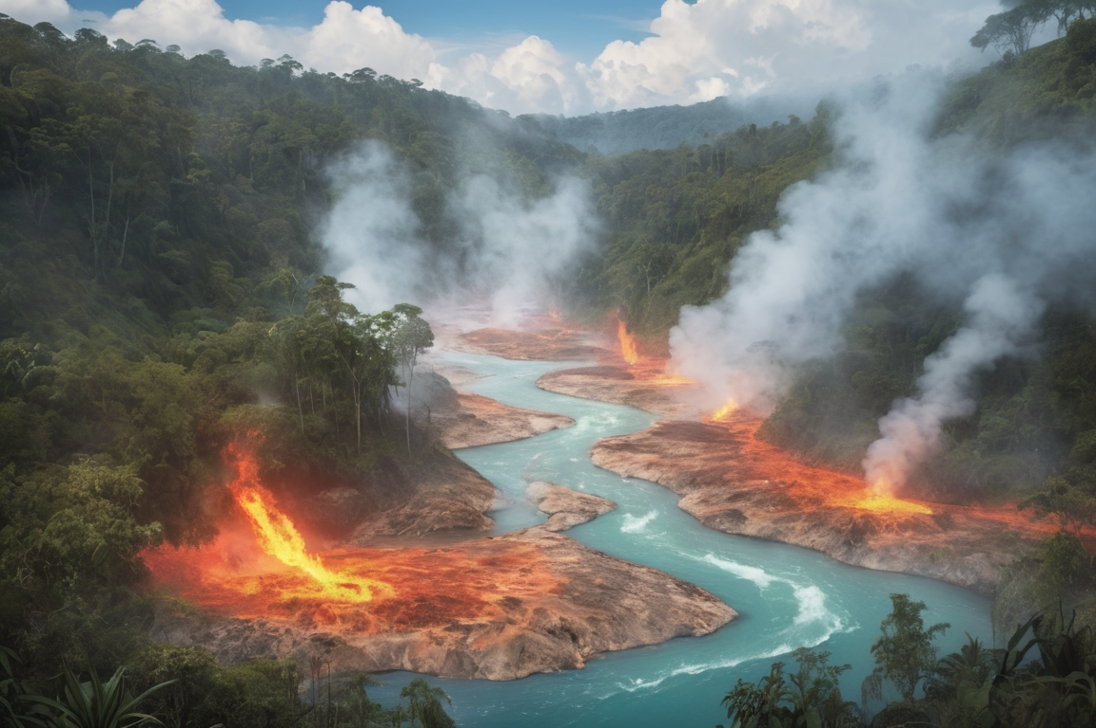
Deep within the world's largest tropical forest flows a boiling river. Located in the eastern part of central Peru, it is a small tributary that eventually feeds into the Amazon.
Heated by geothermal processes in the Earth's crust, the water in the hottest spots can reach 200°F (about 93°C), creating an extreme environment with air temperatures higher than anywhere else in the Amazon.
However, this turbulent river, known locally as Shanay-Timpishka ("boiled by the heat of the sun"), also provides a unique opportunity to study how rising temperatures affect vegetation. During a 2021 expedition, a team of biologists from the University of Miami concluded that the boiling river could serve as a natural experiment.
"This truly gives us a window into the future because the Amazon will inevitably get hotter. Thanks to this, we can understand how rising temperatures will affect forest composition," explained Riley Fortier, lead author of the study published in Global Change Biology and a graduate student in Professor Kenneth Feeley's tropical biology lab. "This will help determine which species may disappear and what tropical forests will look like in the future."
The Boiling River as a Natural Laboratory
In 2022, the team returned to Peru and mapped plants and trees across 70 locations along the river—from its cooler headwaters to the hottest section, where air temperatures frequently exceed 110°F (43°C).
By observing vegetation along approximately a mile of the river and using sensors to measure temperature, researchers made several key discoveries. They found that biodiversity significantly decreased in the hottest areas, with tree diversity dropping by 11% for every degree of warming. Only plants adapted to very warm tropical climates could survive near the boiling river.
"Overall, the hottest zones have lower tree diversity," Fortier noted. "The forest composition here is more uniform, whereas cooler areas support a much wider range of species."
One of the biggest discoveries was how rapidly vegetation changed along the river.
"We saw a clear shift in forest composition: in the hottest zone, species typical of warmer Amazonian regions dominated," Fortier explained. "But moving just a little farther from the river caused a sudden change in species composition. Usually, such dramatic shifts happen over much greater distances."
For example, Fortier and Feeley noticed that in the hottest areas, the forest was drier, with vines and shrubs dominating the vegetation. Trees were smaller and less diverse, and the overall landscape resembled a transition zone between forest and savanna—even though all of this change occurred within less than a mile of dense tropical jungle.
"On large scales, such changes would be expected, but on such a small scale, it's truly rare," Fortier added.
A Natural Experiment for the Future
Feeley's lab plans to continue studying the boiling river, as this unique site may hold the key to understanding the future of tropical ecosystems.
"You can't artificially heat an entire forest, and that's what makes the boiling river so valuable for science," Fortier explained. "It allows us to see how temperature alone affects an ecosystem. Here, rainfall, soil conditions, and humidity remain constant, so we can isolate the effects of warming. This will help us understand how global warming will reshape tropical forests in the future."